Compulsory School Attendance Requirement
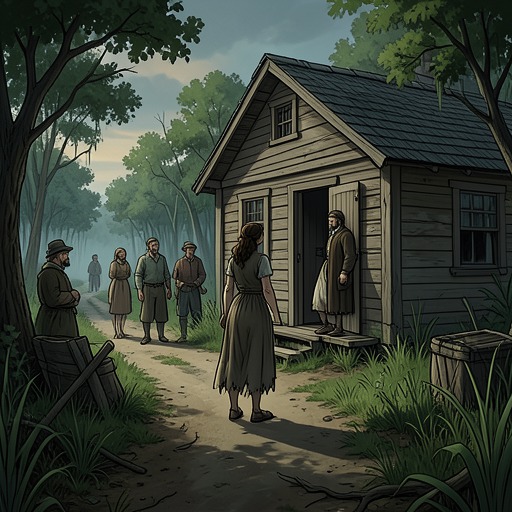
Where the Crawdads SingThe Compulsory School Attendance Requirement is presented through the contrast between an institution that expects Kya Clark to attend school and a child who finds its social world intolerable. She goes only once, after classmates laugh at her, then avoids returning. Truant officers pursue her, but she turns evasion into a practical skill; the novel shows the rule chiefly through that pursuit, not through a detailed account of its statutes or penalties.
The Rule as Enforcement
The account makes compulsory attendance legible through its agents. Kya recalls that after leaving school she spent weeks outsmarting the truant officers. Years later, during the investigation into Chase Andrews’s death, officers describe her as having evaded not only truant officers but census takers and others. Their discussion of how to bring her in—including the suggestion of setting a trap—shows how her history of avoiding official notice has become familiar to them.
That later pursuit concerns questioning in a murder investigation, not a school-attendance charge. The distinction matters: the novel links the officers through Kya’s reputation for evasion, but does not present her arrest or detention as punishment for missing school. Nor does it specify the legal penalties, procedures, or terms of the attendance requirement. Its force in her childhood is conveyed through the persistent possibility that officials may find her and return her to an institution she has already rejected.
Kya’s One Day at School
Kya tells Jodie Clark that she attended school for one day in her life. The decisive circumstance is not a stated objection to learning: the children laugh at her, and she does not go back. Her withdrawal follows a humiliating encounter with classmates, while the attendance system appears in her memory as the pursuit that follows her refusal to return.
Kya recalls that she learned to outsmart the truant officers over the weeks that followed, drawing on what Jodie had taught her. The account gives no particular evasion method, but makes clear that staying away required continued alertness and resourcefulness. What the attendance rule could not accomplish by itself was to make school feel safe or welcome to her; the narrative supplies no account of anyone resolving the mockery that prompted her departure.
Education Outside the Institution
Kya’s absence from school does not mean she remains unable to read or write. When Jodie asks how she learned to read and write the book she produced, Kya credits Tate Walker with teaching her to read. The distinction is central to the rule’s significance: her formal attendance ends almost immediately, but learning continues through personal relationships rather than the school she avoided.
The novel therefore sets institutional attendance beside an education formed elsewhere. It does not claim that Kya received no instruction at all, nor does it detail a complete alternative curriculum. Instead, it records a sharp separation between her brief experience of school, her successful evasion of its attendance enforcers, and the later literacy that Tate helped make possible.
Reach and Limits
The attendance requirement gives officials a reason to search for a child who has disappeared from school, but Kya’s story emphasizes how limited that reach can be when she knows the marsh and can outwit those looking for her. The officers’ later recollection places truant officers among the people she had long managed to evade, making her childhood avoidance part of a broader pattern of staying beyond institutional notice.
The rule’s human consequence is thus double-edged. It marks Kya as someone officials seek to bring back into school, yet the account identifies ridicule—not a lack of capacity to learn—as the immediate reason she refuses to return. Her later literacy, acquired with Tate’s help, does not erase that failed encounter; it shows that learning and compulsory attendance are not identical in her life. The text presents the requirement through this lived conflict while leaving its precise legal form and sanctions unstated.